A few weeks ago, one of our team members dropped a 2x2 matrix in our #ai-chatter Slack channel. Horizontal axis: domain expertise. Vertical axis: AI skill. Four quadrants. I looked at it and thought: this is the whole thing right here.
We’ve been selling AI-powered enrollment tools to higher ed for a few years now. That puts us in an interesting position. We’re on the cutting edge of what AI can do, which means we’re also operating in the territory where some things break because the technology isn’t quite there yet. That’s not a complaint. That’s the deal. You don’t get the learning without the friction, and you don’t get the innovation without operating a little past the edge of what’s proven.
What’s harder is when the market you’re in holds AI to a standard they’d never apply to anything else.
The standard no one applies to humans
When a campus administrator sees an AI agent give a student a wrong answer, the reaction is often swift: this doesn’t work, we can’t use it, it’s not ready. I’ve seen it more than once. One wrong response and the whole system goes on trial.
Nobody applies that logic to a new employee. A new hire gives a wrong answer to a prospective student on their second week. Nobody scraps the hiring program. You correct them, you give them more context, you train them up.
It’s the same argument playing out with autonomous vehicles. A December 2024 study by Waymo and Swiss Re, based on 25.3 million fully autonomous miles driven across Phoenix, San Francisco, Los Angeles, and Austin, found that Waymo vehicles produced 92% fewer bodily injury claims and 88% fewer property damage claims than human drivers over the same distance. Put another way: for that same 25.3 million miles, human drivers would have been expected to generate 26 bodily injury claims and 78 property damage claims. Waymo had two and nine, respectively. (Source: Waymo / Swiss Re, December 2024)
And yet, when an autonomous vehicle makes a mistake, it’s national news. We forgive the human driver every single day. We hold the machine to a standard that doesn’t exist for anyone or anything else.
That’s the situation campuses are in with AI right now. The double standard is real, and it’s costly.
The thing we got wrong
We didn’t fully understand, at least not a year ago, how crucial context engineering was. AI is only as good as what you feed it. The model’s capability matters, but the context, the structure, the specific knowledge you give it, that matters just as much. Maybe more.
Andrej Karpathy, who is about as deep into AI as anyone alive, made the point that 90% of AI mistakes come from missing context, not a weak model. We’ve lived that. When our agents gave poor answers, it usually wasn’t the model. It was what we hadn’t yet given it to work with. That’s on us to build. It’s also the training problem for every campus leader who wants to use AI effectively.
I put it this way in our Slack last month: bad output doesn’t mean AI is untrustworthy. Bad output means insufficient context and skills. Those are solvable problems. Giving up is not a solution.
The four quadrants
So here’s the framework. Two axes: how much AI skill you have, and how much domain expertise. Four places you can land.
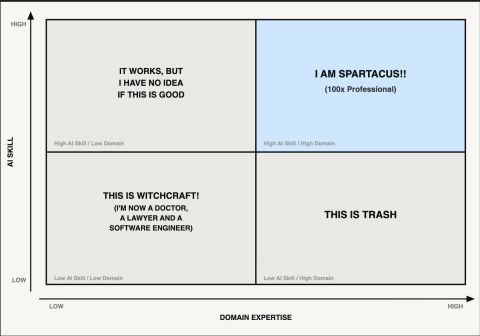
Low AI skill, low domain expertise is the “this is witchcraft” quadrant. You see what AI can do and you feel like you’ve instantly become a doctor, a lawyer, and a software engineer. The outputs look impressive until they’re not. This is a dangerous place to stay, and it’s also where the most uncritical AI hype lives.
Low AI skill, high domain expertise is where most campus administrators are right now. You know your field well enough to catch every mistake the model makes. But you don’t yet have the skills to fix it, or to engineer it better. So you conclude the tool is broken. This is the ostrich quadrant. Head in the sand, waiting for AI to be perfect before engaging with it.
High AI skill, low domain expertise is where a lot of pure builders live. You can ship things fast. You can make AI do impressive things. But you have no idea if the output is actually correct or appropriate for the context you’re operating in. It works, but you have no idea if it’s good.
High AI skill, high domain expertise is the 100x professional. You know your field deeply, and you know how to engineer AI to work within it. You can give the model real context, catch its mistakes fast, and close the gap between what it produces and what you actually need. This is where every organization should be building toward. Not one axis or the other. Both.
What we actually need
The campuses that are going to win over the next decade are the ones willing to do the hard work of building AI skill alongside deep institutional knowledge. That doesn’t happen by waiting for the tools to be perfect. It happens by getting in, making mistakes, learning what context the model actually needs, and improving from there.
We’re trying to build tools that accelerate that process for enrollment teams. We’re also still learning how to do it better ourselves. Neither of those things is finished, and I’d be lying if I said otherwise.